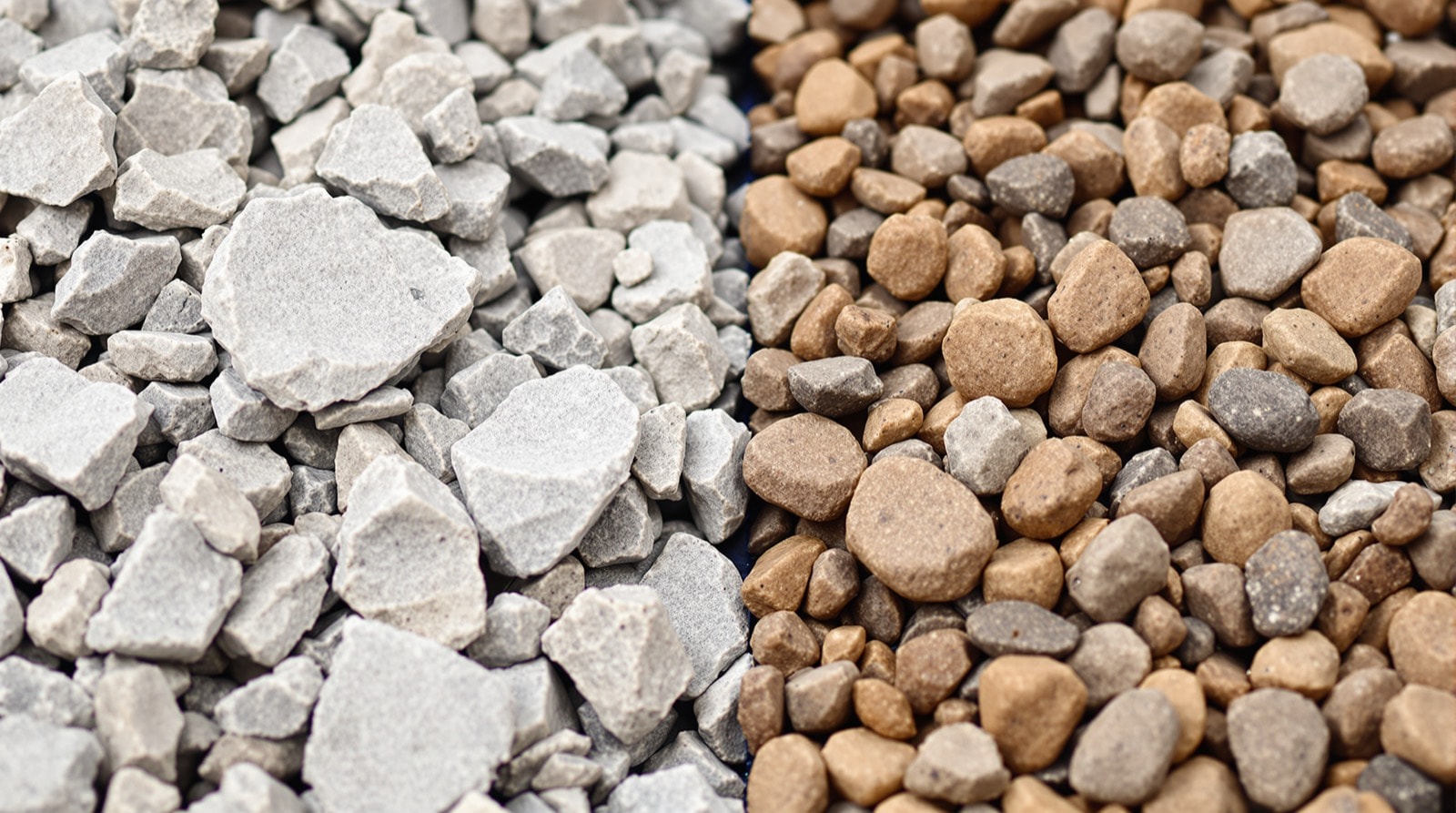
Aggregate occupies roughly sixty to seventy-five percent of the volume of a cubic yard of concrete. It is the cheapest ingredient and the one most often treated as inert filler, which is a mistake: aggregate properties govern paste demand, shrinkage, pumpability, finishability, abrasion resistance and several of the slow chemical failures that show up a decade after a pour.
What aggregate is doing in the mix
Cement paste shrinks as it dries and it is expensive. Aggregate does neither. The engineering objective is therefore to pack as much sound, well-graded stone and sand into the volume as possible while leaving just enough paste to coat every particle and fill every void with a workable margin to spare. A mix with too little paste is harsh, tears when finished and pumps badly; a mix with too much paste is easy to place and shrinks, cracks and costs more.
The nominal maximum size is the first decision. Larger stone reduces the surface area needing coating, so it cuts water and cement demand — but it is capped by the geometry of the placement. Conventional limits keep the maximum size below about one-third of a slab's thickness, one-fifth of the narrowest form dimension, and three-quarters of the clear spacing between reinforcing bars or between bars and the form face. Pumping imposes its own limit relative to line diameter.
Gradation
A well-graded aggregate has particles distributed across the whole size range so that smaller particles occupy the voids between larger ones. Gap-graded combinations — plenty of large stone, plenty of sand, little in between — leave voids that must be filled with paste, and they segregate readily during transport and discharge.
Coarse aggregate is specified against standard grading bands by size number, and fine aggregate against a band expressed through the fineness modulus, a single figure computed from the cumulative percentages retained on the standard sieve series. Typical concrete sand runs between about 2.3 and 3.1; a finer sand demands more water for the same slump, a coarser one finishes rougher.
Where a single source cannot deliver a good overall gradation, producers blend two coarse sizes or add an intermediate fraction. Combined-gradation approaches, which look at the whole aggregate skeleton rather than at each fraction separately, have been adopted by several state transportation departments for paving work and generally reduce paste demand.
Shape, texture and their consequences
Rounded river gravel and angular crushed stone behave differently in the same proportions. Rounded particles roll past one another and need less water for a given slump, which is why gravel mixes are often easier to pump and to finish. Crushed stone interlocks, which gives a modest flexural-strength and bond advantage but demands more paste and produces a harsher mix.
Flat and elongated particles are undesirable in either material. They align during consolidation, trap bleed water beneath themselves, weaken the paste-aggregate interface and increase the fines generated in handling. Standard specifications cap the proportion of such particles.
Texture matters at the interfacial transition zone — the thin, weaker, more porous layer of paste immediately around each particle. A rough surface gives mechanical keying there; a smooth, dust-coated one does not, which is why excess material passing the No. 200 sieve is limited. Washing is the usual remedy.
Moisture, absorption and the batch water problem
Aggregates hold water in two places: inside the particle, absorbed into its pore structure, and on the outside as free surface moisture. Only the free moisture belongs to the mixing water. The reference condition is saturated surface-dry, at which the particle is internally full but externally dry and neither takes water from nor gives water to the paste.
Real stockpiles are never at that condition. A sand pile after rain can carry six or seven percent free moisture at the base and two percent at the top, and every percentage point is a meaningful quantity of unintended water in the batch. Plants run continuous probes and correct automatically, but the correction depends on where the probe sits and on how the pile is worked. Sudden slump changes with no other explanation are usually a moisture story.
High-absorption lightweight aggregates invert the problem usefully. Pre-soaked lightweight fines release their internal water slowly into the hardening paste, providing internal curing from the inside out — increasingly used in low-w/cm mixes where external curing water cannot penetrate.
Durability problems that arrive late
Alkali-silica reaction is the best known. Certain reactive silica phases — opal, chert, strained quartz, some volcanic glasses — react with alkalis in the pore solution to form a gel that swells when it takes up water, cracking the concrete in a characteristic map pattern over five to twenty years. Prevention is a combination of aggregate testing, limits on total alkali content, and generous use of supplementary cementitious materials, which bind alkalis and lower pore-solution pH. Lithium admixtures are available where a reactive aggregate cannot be avoided.
D-cracking affects certain porous carbonate coarse aggregates in freezing climates: the particle itself becomes critically saturated and fractures, producing cracking parallel to joints in pavements. It is controlled by source acceptance testing and, in some jurisdictions, by reducing the maximum aggregate size.
Deleterious substances — organic matter, clay lumps, friable particles, coal and lignite, chert of low specific gravity — are each capped by standard limits because each has its own failure mode, from retarded set to popouts.
Supply and the reason it is local
Aggregate is high-mass and low-value, so haul distance dominates its delivered cost more than for any other concrete ingredient. Beyond thirty to fifty miles by truck the freight exceeds the material, which is why aggregate is quarried and dredged close to the market it serves and why concrete character changes across regions. The United States Geological Survey crushed stone statistics series documents national production and the persistent local character of the trade.
Acceptance testing for public work generally follows state transportation department procedures — the Texas Department of Transportation materials programme is a representative example — layered on top of the national standards published by ASTM International.
Related reading: mix design, and the regional aggregate notes for North Texas, the Gulf Coast and central Arkansas.