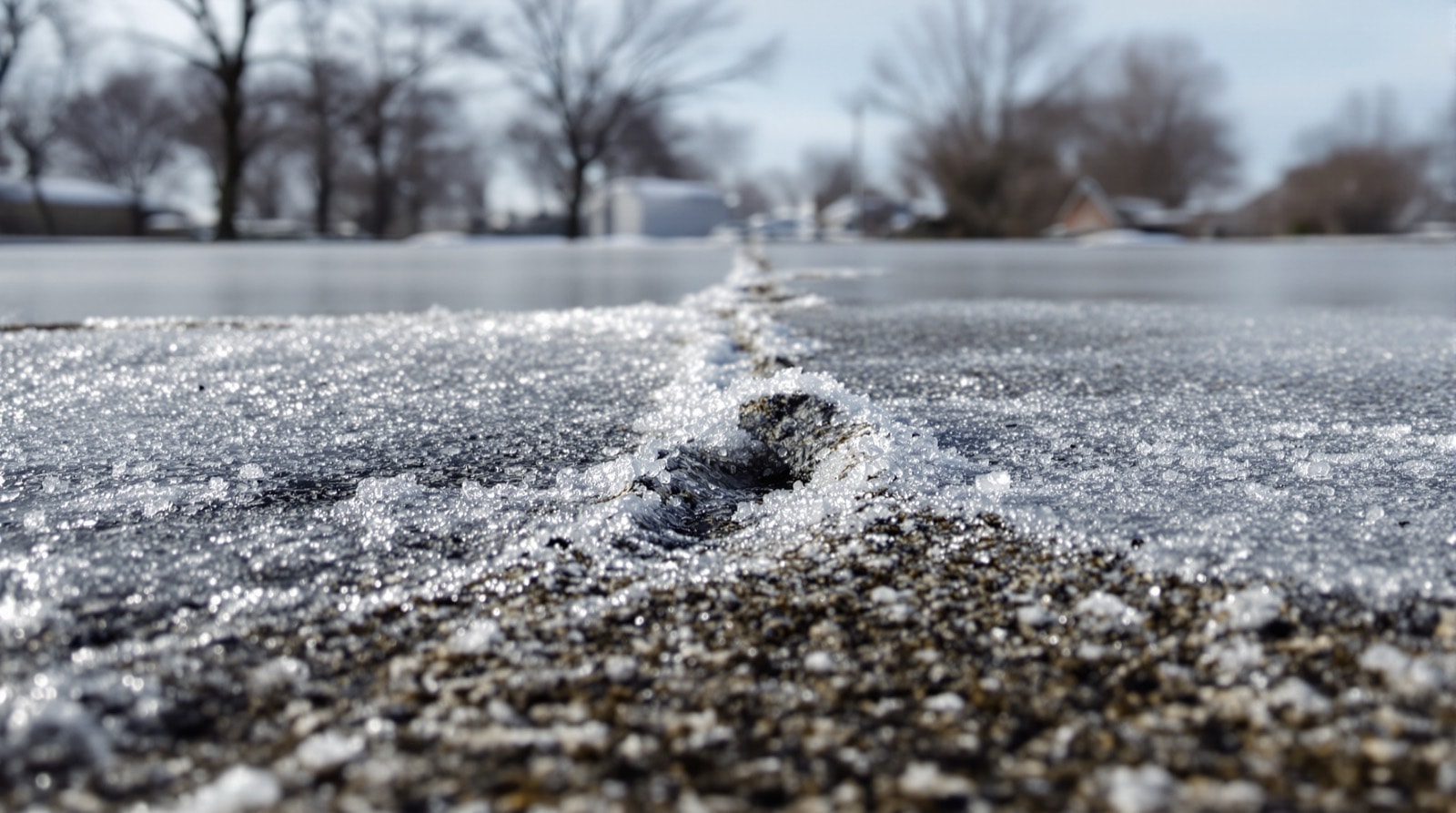
Central Arkansas sits on a geological seam. North and west are the folded Ouachitas and the Arkansas River Valley, with hard sound rock. South and east is the Mississippi embayment, flat and alluvial. The Arkansas River runs between them. A concrete market on that seam has choices about materials that most markets do not, and a climate that requires it to run two different operating régimes each year.
Aggregates: an unusual local choice
Crushed hard rock is available locally — sandstone, novaculite, and igneous syenite from the intrusive bodies south-east of the city, quarried for well over a century for aggregate and dimension stone. So is rounded siliceous river sand and gravel from the Arkansas River system and the alluvial plain. Limestone is available from the north.
Having both is genuinely useful. Crushed angular stone gives better mechanical interlock, higher flexural strength and better abrasion resistance, which suits pavements, industrial floors and bridge decks. Rounded gravel needs less water for the same slump, pumps more easily and finishes more readily, which suits building work and residential flatwork. A specifier here can choose on technical grounds rather than accepting whatever the region has, and a producer can carry both. The trade-offs are set out under aggregates.
Freeze-thaw: the defining regional difference
This is what separates Arkansas practice from Gulf Coast practice. Central Arkansas has a real freezing season — moderate by northern standards, but with enough cycles that concrete which is saturated and exposed will be damaged unless it is air-entrained.
Deliberately entrained air is the only effective protection. A surfactant admixture produces a system of microscopic, closely spaced, stable bubbles that give freezing pore water somewhere to expand into; what governs performance is the spacing between bubbles, though what gets measured on site is total air percentage. Exterior concrete is therefore specified with an air content range appropriate to the exposure severity and the maximum aggregate size, and both ends of the range are enforced, because every percentage point of air costs roughly five percent of compressive strength.
Deicing chemicals sharpen the requirement. Salt scaling attacks the surface mortar of concrete that is air-entrained but insufficiently mature or poorly cured, so parking structures, bridges and commercial flatwork here carry lower water-cement ratio limits and longer curing requirements than an equivalent structure further south. Guidance on exposure classes comes from the American Concrete Institute code.
There is also an aggregate dimension: certain porous carbonate coarse aggregates become critically saturated and fracture internally on freezing, producing the joint-parallel cracking known as D-cracking in pavements. Source acceptance testing carries real weight in a freezing market for exactly this reason.
Two seasons, two operating régimes
Summers here are hot and humid, so the Gulf Coast measures apply: early starts, cooled water, prompt curing, long waits for bleed water. Winters bring genuine cold-weather concreting: heated mixing water, insulating blankets and enclosures, protection until the concrete passes the strength threshold below which freezing causes permanent damage, and then a controlled, gradual removal of that protection so the surface does not crack from thermal shock.
Direct-fired heaters inside an enclosure carry their own trap: combustion products raise carbon dioxide levels, and carbonation of a fresh surface leaves a soft, chalky, permanently weak wearing layer. Vent them outside. The full hot- and cold-weather régimes are set out under curing and protection.
Ground conditions
Conditions vary substantially over short distances because of the geological boundary. Alluvial soils along the river are soft and compressible with shallow groundwater; upland areas have residual soils over rock, sometimes with rock close enough to the surface to require excavation; and there are expansive clays in places, though generally less aggressive than the Cretaceous clays of North Texas. Flood-plain construction brings its own hydraulic and scour requirements.
The practical consequence is that geotechnical investigation earns its fee here more than in a uniform market: two sites a mile apart can require entirely different foundations, and the concrete follows the foundation.
Public works and their parallel rules
State highway and bridge work forms a meaningful share of regional concrete demand, and it operates under transportation department specifications rather than the building code: approved materials lists, formal mix approval, prescribed testing frequency, and certified technicians. A producer serving both markets maintains two documentation régimes. The distinction is described under standards.
Where to look next
Market structure, plant network and scheduling are covered under ready-mix supply in central Arkansas. Air content measurement and hardened air-void analysis are under testing.