Central Arkansas is a much smaller ready-mix market than either Texas metroplex, and its character comes from that scale as much as from its geology. A market of this size supports fewer plants, shorter mix catalogues and closer working relationships between producer, contractor and specifier — and it is large enough to sustain proper laboratory capability, which many markets of comparable size are not.
A market defined by its geology
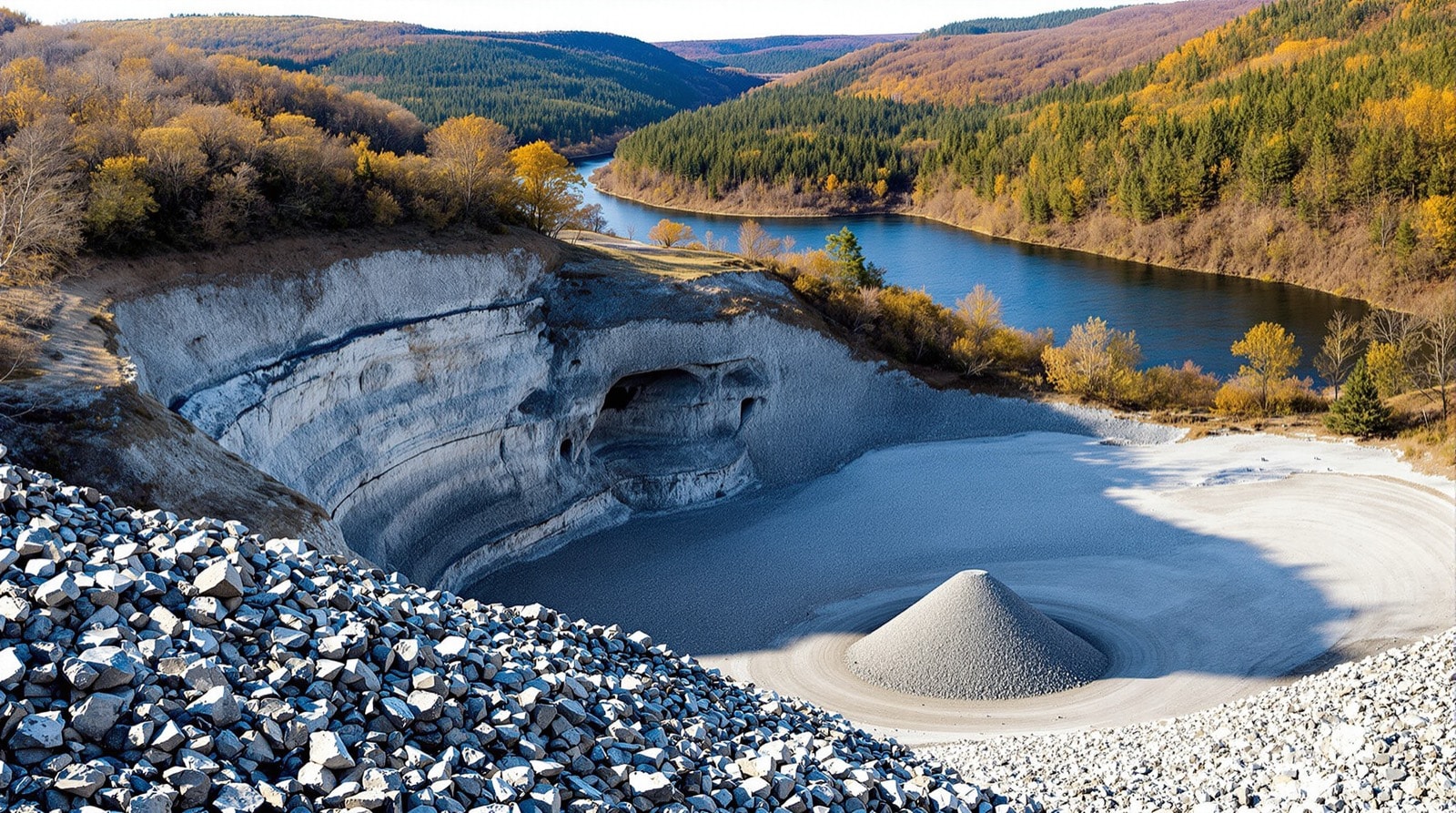
The Little Rock area sits on a geological boundary that is directly useful to a concrete supplier. To the north and west lie the Ouachita Mountains and the Arkansas River Valley, with hard, sound rock: sandstone, novaculite and igneous intrusions including the syenite bodies around Granite Mountain, quarried for aggregate for well over a century. To the south and east lies the Mississippi embayment, flat alluvial and coastal-plain material with river sand and gravel.
The practical result is that both crushed hard rock and rounded river gravel are available locally, which is unusual. Producers can choose the aggregate that suits the application rather than the one the region happens to have: crushed syenite or sandstone where abrasion resistance, flexural strength or bond matter, river gravel where pumpability and finishing ease dominate. The Arkansas River corridor supplies both the sand and the barge transport.
Freeze-thaw at the margin
This is the practical difference between Arkansas concrete and Gulf Coast concrete. Central Arkansas experiences a real, if moderate, freezing season — enough freeze-thaw cycling that exterior flatwork exposed to moisture requires entrained air, and enough winter weather that cold-weather protection is a routine part of the schedule rather than an exceptional measure.
That has three consequences. Exterior mixes carry an air-entraining admixture with a specified air content range, and both the minimum and the maximum are enforced, because air costs strength. Deicing chemical exposure on parking structures, bridges and commercial flatwork drives lower water-cement ratios and greater curing discipline than an equivalent structure further south would need. And the winter placement season requires heated water, insulating blankets, enclosures and a protection plan, described under curing and protection.
Freeze-thaw durability is also an aggregate-selection question: certain porous carbonate aggregates fracture internally when critically saturated and frozen, so source acceptance testing carries weight here that it does not carry in a non-freezing market. The mechanism is described under aggregates.
Demand mix
The demand base is broader and less cyclical than in a market driven by a single industry: state government and institutional construction, a substantial medical and research sector, distribution and manufacturing along the interstate corridors, transportation work on the state highway network, and a steady residential market. Agricultural and food-processing construction adds demand in the surrounding counties, and river-related infrastructure adds a certain amount of specialised marine and hydraulic work.
Transportation work deserves separate mention because it imports its own rules. Highway and bridge concrete is governed by state transportation department specifications with their own approved materials lists, mix approval process, testing frequency and technician certification requirements — a parallel régime to the building-code route described under standards.
What a smaller market changes
Three things, in practice.
Lead time behaves differently. With fewer plants and a smaller truck fleet, a large placement occupies a meaningful share of regional capacity, so scheduling conversations happen earlier and hold more weight. Conversely, a modest pour can often be accommodated at short notice in a way a saturated metropolitan market cannot manage.
Mix catalogues are shorter. A market this size cannot economically maintain dozens of niche designs, so specifications that call for an unusual combination need genuine lead time for trial batching and submittal rather than being pulled off a shelf.
Winter and summer are both constraints. Unlike the Gulf Coast, where heat is the year-round variable, central Arkansas has a hot, humid summer and a genuine winter, so a producer's operating practice has to swing between hot-weather and cold-weather régimes twice a year.
Materials and standards context
National materials supply data is published by the United States Geological Survey; the technical guidance that governs proportioning and durability comes from the American Concrete Institute; and plant equipment and batching practice are covered by the National Ready Mixed Concrete Association certification programme described under plant types.
Regional practice notes are on the central Arkansas practice page.
A note on this page
This is an independent reference. It describes the regional market in general terms and does not list, endorse or represent any producer, plant or supplier, past or present.