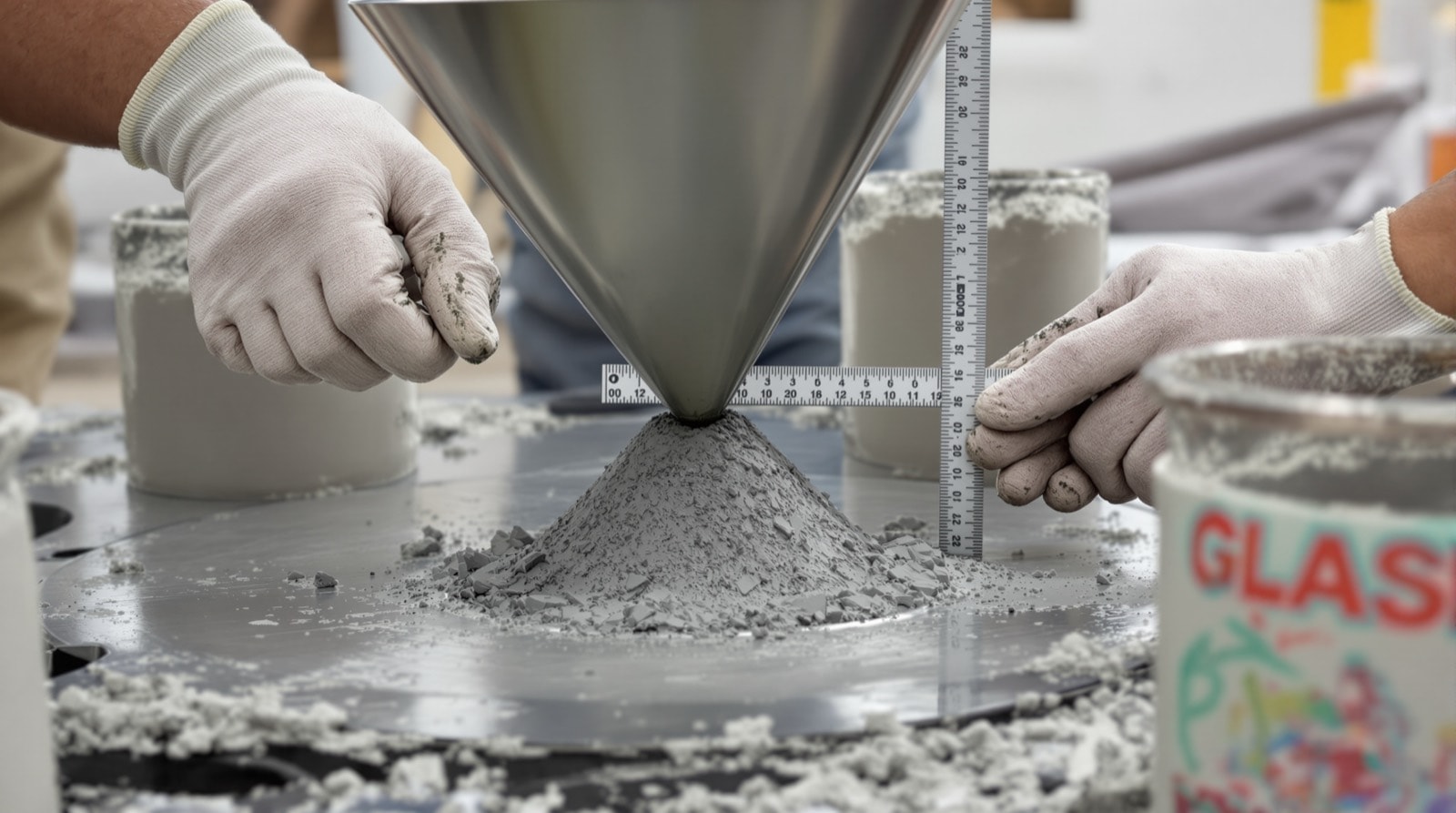
Concrete testing exists to answer two separate questions: is this load acceptable to place, and did the structure receive the material that was specified. The first is answered in minutes at the discharge chute; the second, weeks later, in a laboratory. Confusing the two is the origin of a remarkable share of construction disputes.
Sampling, which is where most bad results begin
A test result describes the sample, not the truck. Standard practice requires a composite sample taken from two or more regularly spaced portions of the middle of the discharge — never the first material out, never the last, never from the top of a wheelbarrow. The portions are remixed in the pan before any specimen is made, transport to the test point is limited, and all specimen fabrication must begin promptly.
Where a sample is taken also matters when concrete is pumped. Pumping changes air content, and material sampled at the truck can differ measurably from material sampled at the point of placement. Which location governs is a specification decision that should be settled in the pre-construction meeting rather than argued about after a failing air test.
Fresh concrete tests
Slump. A truncated cone is filled in three equal layers, each rodded twenty-five times, struck off, and lifted vertically in a few seconds; the subsidence of the concrete is the slump. It is a consistency test, not a workability test and certainly not a strength test, but it is fast and it is sensitive: an unexpected slump change means something changed — aggregate moisture, admixture dosage, batch water, or time and temperature since batching.
Temperature. Trivial to measure and disproportionately informative. Concrete temperature governs the rate of slump loss, the finishing window and early strength, and most specifications set both an upper limit for hot weather and a lower limit for cold-weather placement.
Air content. Measured by the pressure method for normal-weight concrete and the volumetric method for lightweight. Air is the freeze-thaw defence, and it is also a strength variable, so both a minimum and a maximum are normally specified. Air content changes during handling: it can be reduced by pumping, by long belt conveyors and by over-vibration, and it can be increased by certain admixture interactions.
Density and yield. Weighing a known volume gives the fresh density, and dividing the total batch mass by that density gives the actual volume produced. Yield testing is the honest answer to a persistent site complaint that loads are short — most apparent shortfalls turn out to be subgrade tolerance, form deflection or over-excavation rather than batching.
Record the conditions, not just the number
A result without context is difficult to interpret. The field record should connect each sample to its delivery ticket, identify the sampling point and discharge portion, and show the times of sampling and each test. It should also capture concrete and ambient temperature, the test method, equipment identification, technician, specimen marks and any visible departure from the planned procedure. Those entries help separate material variability from sampling, handling and environmental effects.
Photographs can preserve the test setup, the condition of the sample and the initial storage arrangement, but they do not replace a complete written record. Note any water or admixture adjustment shown on the delivery ticket, the mixing that followed it, and the location where cylinders spent their first day. If a result later prompts an investigation, these ordinary details establish which question the number can actually answer.
Making cylinders correctly
Standard cylinders are made in either 6-by-12-inch or 4-by-8-inch moulds, consolidated by rodding or vibration in the prescribed number of layers, struck off, capped against evaporation and left undisturbed on a level, vibration-free surface for the first day. Initial curing must hold them within a controlled temperature band; they are then transported carefully and stored in a moisture room or lime-saturated water bath until testing.
Almost every low break that is later shown to be a testing artefact traces to this sequence: cylinders left in the sun, cylinders on a plank over a trench, cylinders rattling in a pickup bed at one day, cylinders never placed in the curing tank. Field technicians for acceptance testing are normally required to hold a recognised certification for exactly this reason, and the American Concrete Institute certification programmes are the usual instrument.
Specimen size is not neutral. Four-inch cylinders show slightly higher average strength and greater scatter than six-inch cylinders of the same concrete. Whichever is used, it must be used consistently for a project's strength record.
Compressive strength testing and acceptance
Cylinders are capped or ground to produce plane, perpendicular ends, then loaded at a controlled rate to failure. A test is the average of at least two cylinders from the same sample, not a single cylinder, and acceptance is judged against two conditions applied together: the average of any three consecutive tests equals or exceeds the specified strength, and no individual test falls below it by more than a defined margin.
The fracture pattern is diagnostic and worth recording. Well-formed cones indicate a sound specimen; columnar or shear-plane failures often indicate poor end preparation or misalignment rather than weak concrete.
When results are low, the sequence of enquiry is: check the test records and the technician's practice first, then the delivery tickets and batch records, and only then investigate the structure by coring, by rebound or pulse-velocity survey, or by load testing. Cores tell you about the concrete as placed and cured in the structure, which is a different question from whether the producer supplied the specified mix, and the two answers frequently differ.
Field-cured specimens serve a different purpose
Standard-cured cylinders assess the mixture. Field-cured cylinders, stored beside the element and exposed to the same conditions, assess the adequacy of curing and protection — they are the instrument for deciding when to strip forms, remove shoring, apply post-tensioning or open a floor to traffic. Substituting one for the other in an acceptance argument is a category error.
Maturity methods offer a more capable alternative for time-critical work: after a laboratory calibration relating strength to the accumulated product of temperature and time, embedded sensors give a continuous in-place strength estimate. Calibration is mix-specific and must be redone whenever the mixture changes.
Durability and non-destructive testing
Strength is a poor proxy for durability, so specifications increasingly call for direct measures: rapid chloride-ion penetrability or bulk resistivity for permeability, length-change testing for drying shrinkage, freeze-thaw resistance and scaling resistance for exposed flatwork, and hardened air-void analysis of polished sections when the fresh air content is disputed.
On existing structures, rebound hammers give a rough surface-hardness comparison, ultrasonic pulse velocity finds voids and delamination, cover meters and half-cell potential surveys assess reinforcement and corrosion risk, and petrographic examination of a core is the definitive tool for diagnosing alkali-silica reaction, sulfate attack, carbonation depth and freeze-thaw damage. Research programmes at the National Institute of Standards and Technology and the Federal Highway Administration underpin much of this practice.
Related reading: mix design for where the target strength comes from, and curing for the variable that field-cured specimens are measuring.