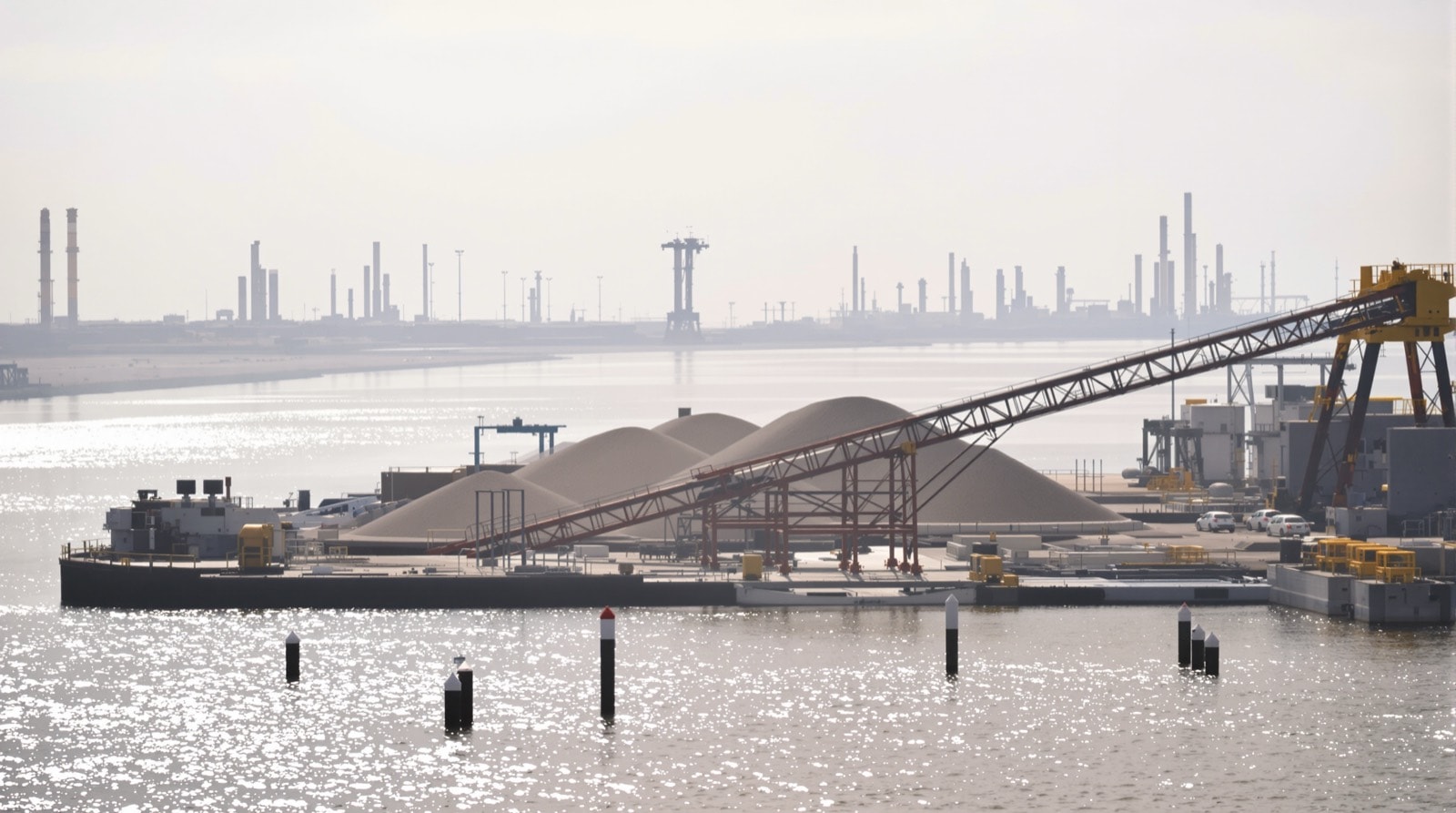
The Houston region buys concrete on a different footing from the rest of Texas. Its two largest consumers are heavy industry along the ship channel and the coastal petrochemical corridor, and a residential market spread across a very large, very flat, very wet coastal plain. Between them sits a medical and commercial core with conventional structural demand. The supply network reflects all three.
Industrial demand sets the technical bar
Refinery, chemical and terminal work brings requirements that ordinary building construction rarely sees: mass foundations for vessels and compressors where the concern is thermal cracking rather than strength; sulfate-resistant and chemically resistant mixes; secondary containment slabs and dikes specified for low permeability; equipment foundations with tight tolerance on shrinkage and on anchor-bolt geometry; and turnaround work compressed into narrow shutdown windows where a delivery failure has consequences measured in shift hours.
Two structural implications follow for a supplier. Mass placements need mixes designed around temperature: high supplementary cementitious material replacement to slow heat generation, cooled mixing water or ice, sometimes liquid nitrogen injection, and a thermal control plan that limits both peak core temperature and the differential between core and surface. And plants serving industrial clients must be able to sustain very high delivery rates for many consecutive hours, which is a fleet and dispatch capability rather than a batching one.
Materials and their consequences
The coastal plain has no local hard rock. There is no quarry within the metropolitan area, so coarse aggregate is imported — siliceous river gravel from the Brazos and Colorado systems, and crushed limestone hauled from the Hill Country quarries or brought in by water. Aggregate freight is therefore a much larger share of delivered concrete cost here than in North Texas, and barge and rail terminals along the waterway are strategic assets rather than conveniences.
The regional preference for rounded river gravel has real technical effects. Gravel mixes pump well, finish easily and need less water for a given slump, which is a genuine advantage in a market with heavy pumping and long finishing operations in high humidity. Against that, certain Gulf Coast gravels contain reactive siliceous constituents, so alkali-silica reaction mitigation — supplementary cementitious materials, alkali limits, aggregate testing — is standard practice rather than an optional precaution. The United States Geological Survey documents the regional production pattern that produces this dependence on imported stone.
Climate is the operating constraint
Delivery here is organised around heat and humidity for most of the year. High ambient temperature accelerates slump loss and shortens the discharge window; high humidity slows evaporation, which reduces plastic shrinkage risk but greatly extends the wait for bleed water to leave a slab before finishing can begin. The combination produces the region's signature scheduling pattern: very early starts, large night placements in summer, and finishing crews working long past the concrete's arrival.
Rain is the other operating variable. An afternoon convective storm can arrive with little warning during placement, and the standard response — covering, protecting fresh surfaces, and refusing to finish water into the surface — has to be planned rather than improvised. Suppliers in this market are used to loads being held, diverted or cancelled at short notice, and the commercial handling of that is described under procurement and terms.
Worker heat exposure is a regulated matter as well as a productivity one; the Occupational Safety and Health Administration publishes the applicable guidance, and the hot-weather concreting measures themselves are covered under curing and protection.
Ground conditions
The coastal plain is soft, wet and flat. Groundwater sits close to the surface across much of the region, deep foundations are common for anything substantial, and historic subsidence from groundwater withdrawal has left parts of the area sensitive to differential settlement. Drainage and detention requirements have grown steadily stricter since the major flood events of recent decades, which has increased demand for paving, channel work and detention-structure concrete.
For flatwork, the practical concerns are a saturated subgrade that cannot absorb bleed water, vapour retarder placement under slabs receiving moisture-sensitive floor coverings, and the long finishing windows that high humidity produces. The durability side — chloride exposure near the coast, sulfate exposure in some soils, and the low-permeability mixes that answer both — is covered on the Gulf Coast practice page.
Network shape
Plants in this market are distributed rather than centralised, sited along the radial freeways and the beltways and clustered near the industrial corridor and the aggregate terminals. Because the metropolitan area is unusually large in land area and largely unzoned in its core city, plant siting is governed more by land availability and traffic access than by zoning categories, and the network extends well out into the surrounding counties following residential growth.
Delivery-window arithmetic and the reason a plant map is really a drive-time map are set out under delivery geography; the equipment differences between plant types are under plant types.
A note on this page
This is an independent reference. It describes the regional market in general terms and does not list, endorse or represent any producer, plant or supplier, past or present.