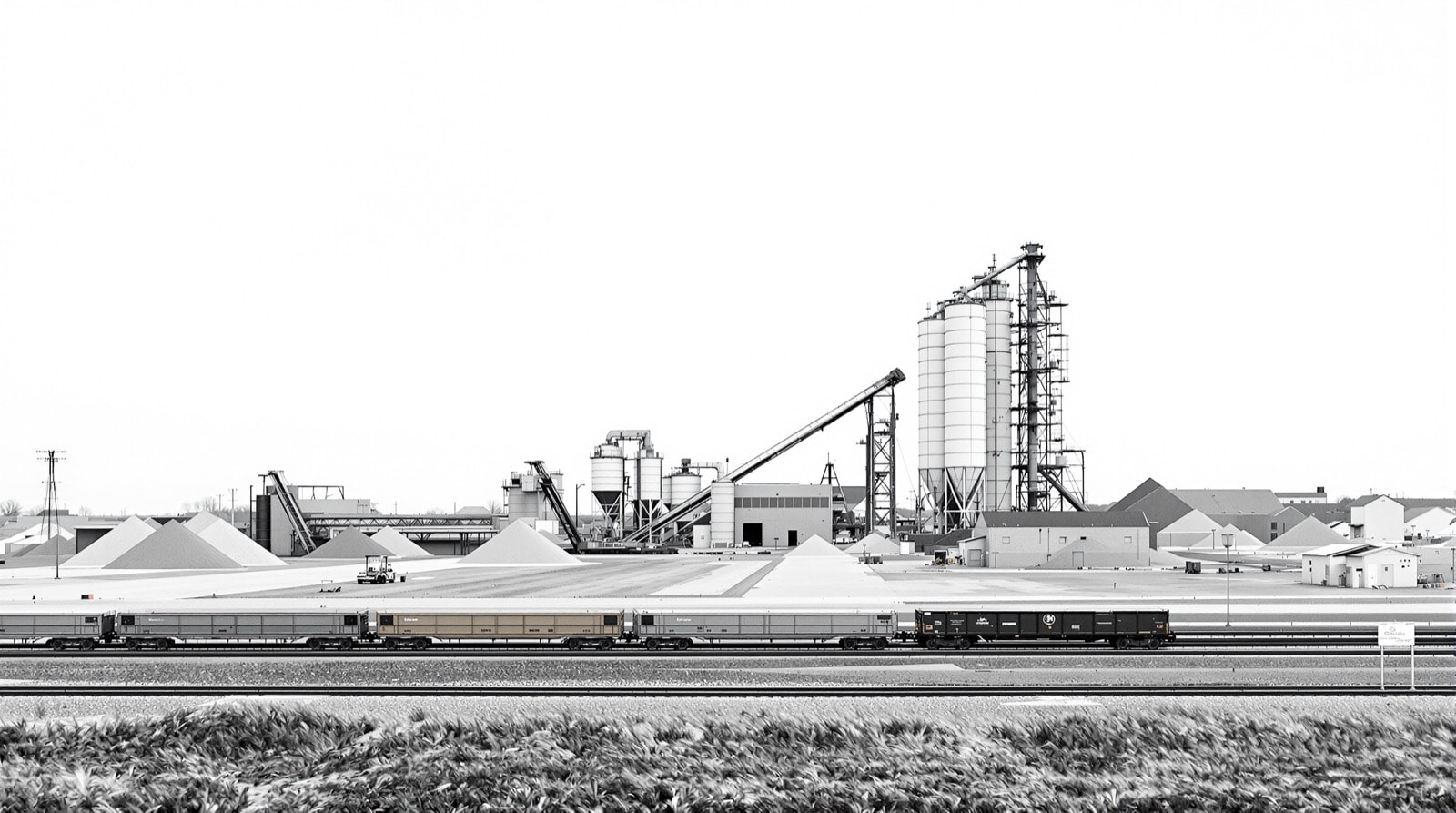
Ready-mixed concrete is an unusual industry. Its product cannot be stored, cannot be shipped far, and cannot be imported. Every cubic yard is made to order within an hour or so of the place it will be used, from materials that are themselves too heavy to travel economically. Those constraints, rather than any regulatory or historical accident, produce the industry's shape.
A local business by physical necessity
Three properties of the material determine everything. It has a useful life measured in tens of minutes. It has a low value-to-mass ratio, so freight dominates cost quickly. And its principal ingredient by volume, aggregate, has an even lower value-to-mass ratio.
The result is a market that is intensely local. A plant competes with the other plants inside its own drive-time envelope and with nobody else. National and multinational ownership exists, but it is a portfolio of local monopolies and duopolies rather than a national market in any meaningful competitive sense — which is why the industry has consolidated repeatedly through acquisition of local positions rather than through anyone building a national plant network from scratch.
The value chain
Working backwards from the truck:
- Cement manufacture — capital-intensive, concentrated in a relatively small number of plants sited on limestone deposits, and energy-intensive enough that fuel and carbon policy are strategic variables. National production and consumption figures are published by the United States Geological Survey.
- Aggregate production — quarries, sand and gravel pits and dredging operations, permitted with difficulty near urban areas and therefore strategically valuable when close to a market.
- Supplementary cementitious materials — fly ash from coal generation, slag cement from iron production, silica fume, and natural pozzolans. Supply is a by-product of other industries and has become less predictable as those industries change.
- Admixture manufacture — chemically sophisticated, high-value, low-volume, and largely in the hands of specialist suppliers who provide substantial technical service alongside the product.
- Ready-mix production — the batching, mixing and delivery operation described under plant types.
- Placement — concrete contractors, finishers, pumping services and testing laboratories, generally separate businesses from the producer.
Vertical integration is common but not universal. A producer that owns its aggregate supply is insulated from the most volatile input cost and from the permitting risk attached to it; one that owns cement capacity has a strategic position but also a large fixed-cost base to keep loaded.
Economics
A ready-mix operation is a fixed-cost business dressed as a variable-cost one. Plant, trucks, drivers, dispatch and quality control must be maintained whether or not volume arrives, and construction volume is famously cyclical. Utilisation therefore drives profitability far more than price does.
Delivery cost is the term operators watch hardest, because it is where the fixed and variable costs meet. Cycle time — the total round trip from loading to loading — determines how many yards a truck can deliver in a shift, and therefore how many trucks and drivers a given volume requires. A site that wastes fifteen minutes per load imposes a real cost that has to land somewhere, which is why waiting time beyond an allowance is normally chargeable. The commercial mechanics are set out under procurement and terms.
Seasonality compounds it. In climates with a real winter, a large fraction of annual volume is delivered in a few months, and the fleet must be sized for the peak while being paid for all year.
Quality assurance as an industry function
Because the producer and the purchaser share responsibility for the finished product, the industry has built a formal apparatus around the boundary between them: standard purchase specifications, batch documentation on every delivery ticket, plant certification programmes, and certified field technicians whose competence is independently attested. The National Ready Mixed Concrete Association operates the principal plant and truck certification programmes, and the American Concrete Institute the principal personnel certifications.
The effect is that a specification can invoke these programmes by reference instead of writing out plant equipment requirements, and the parties can argue about a documented ticket rather than about recollections. Where a dispute does arise, the sequence for investigating it is set out under testing.
Pressures on the industry now
Three, broadly. Carbon — cement manufacture is a significant source of industrial carbon dioxide, and the responses run from blended portland-limestone cements and higher supplementary material replacement through to alternative binders and carbon dioxide injection. Materials supply — declining coal generation has reduced fly ash availability, and urban aggregate permitting grows harder each decade, lengthening hauls. Labour — commercial drivers and skilled finishers are scarce in most markets, which shows up as lead time rather than as price. Career structures in the industry are described under working in ready-mix.
About this reference
This site is an independent, non-commercial reference on ready-mixed concrete. It is not affiliated with, endorsed by or connected to any concrete producer, supplier, trade association or manufacturer, and it names none. Nothing on it is offered for sale and no products or services are provided. Where a technical value matters, the governing standard is cited so readers can consult the primary document. Roles inside a producer's organisation are described under who runs an operation.