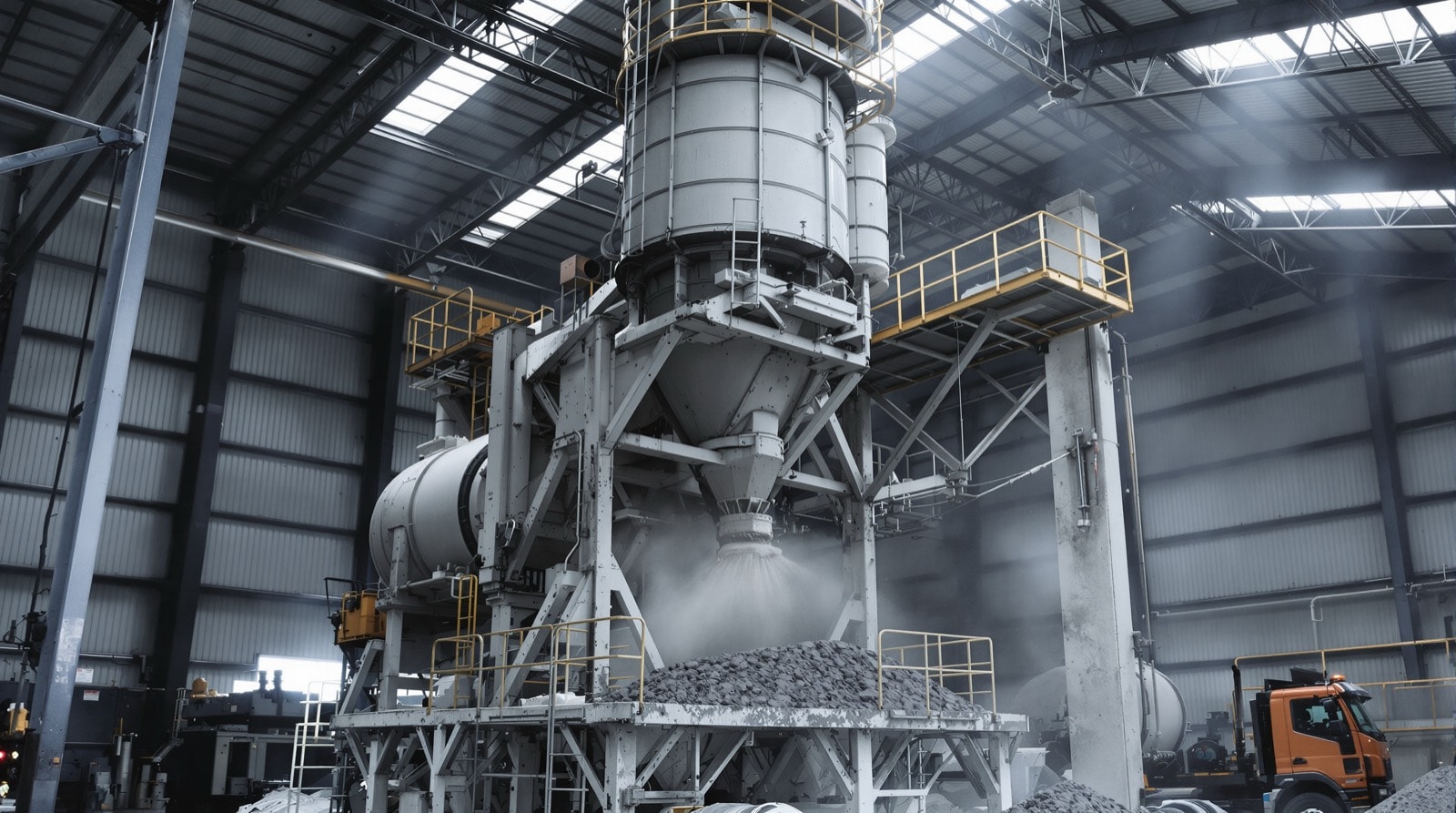
A ready-mix plant is a materials-handling machine with a chemistry problem attached. Its job is to proportion four to six ingredients accurately by mass, combine them into a homogeneous mixture, and discharge that mixture into a truck within a few minutes, repeatedly, all day. How thoroughly the mixing happens at the plant rather than on the road is the distinction that defines the plant types.
The common elements
Every plant, whatever its type, has the same functional blocks:
- Aggregate storage — ground stockpiles fed by a loader, or overhead bins fed by conveyor. Stockpile management is a quality issue: segregation from careless coning, contamination from a dirty pad, and moisture variation with depth all reach the mix.
- Cementitious storage — sealed silos for cement and for each supplementary material, filled pneumatically from bulk tankers, with filters on the vents.
- Weigh batchers — separate load-cell hoppers for aggregates, cementitious materials and water, each with tolerance requirements on the delivered mass.
- Admixture dispensers — volumetric or mass dispensers, usually with their own calibration record, dosing at rates measured in ounces per hundredweight of cementitious material.
- A control system — which holds the mix designs, applies aggregate moisture corrections in real time, records what was actually batched, and prints the delivery ticket.
The delivery ticket is the plant's product as much as the concrete is. It carries the batch time, the mix identification, the quantities, the water added and the water withheld, and it is the document against which acceptance is later argued.
Central-mix plants
A central-mix or wet-batch plant contains a stationary mixer — tilting drum, horizontal shaft, twin shaft or pan — that fully mixes the batch before it is discharged into the truck. The truck's drum then acts as an agitator only, keeping the mixture homogeneous in transit.
The advantages are consistency and speed. Mixing energy is controlled and repeatable rather than depending on drum condition and revolution counts; batch-to-batch uniformity is measurably better; discharge into the truck takes well under a minute, so cycle times are short. Central mixing is the norm where uniformity matters most — paving, high-volume structural pours, mass concrete — and where a plant is running near capacity.
The costs are capital and maintenance. A central mixer is an expensive machine with wearing parts in an abrasive environment, and it becomes the single point of failure for the whole plant.
Transit-mix and dry-batch plants
A dry-batch plant weighs the ingredients and drops them straight into the truck drum, where mixing occurs during the haul at mixing speed for a specified number of revolutions, after which the drum is slowed to agitating speed. The plant itself is simpler, cheaper and easier to relocate.
The trade-off is that mixing quality now depends on the truck: on drum and blade wear, on the revolution counter, on the driver's discipline. Worn blades in a high-mileage drum can fail to mix properly at the nominal revolution count, and the standard purchase specification recognises this by requiring uniformity testing to demonstrate that a given drum still mixes adequately.
Many plants operate as shrink-mix installations, a deliberate hybrid: the batch is partially mixed in a stationary mixer to knock down the volume and start the reaction, then finished in the truck. This buys much of the uniformity of central mixing with a smaller mixer.
Volumetric mobile mixers
A separate category worth knowing. Volumetric mixers carry unmixed ingredients in compartments on the truck and proportion and mix continuously at the point of placement, with a governing standard of their own. They suit small, scattered or unpredictable quantities, remote sites and situations where the required volume is genuinely unknown until the excavation is open, since only what is used gets mixed. Their proportioning is volumetric rather than gravimetric, so calibration and verification practice differs from plant-batched concrete.
Why plants are where they are
Plant siting is dictated by three constraints pulling against one another. The plant must be close to its aggregate supply, because aggregate freight is expensive relative to the material. It must be close to its market, because mixed concrete has a delivery window measured in tens of minutes. And it must be somewhere that industrial traffic, dust and noise are tolerated, which is increasingly hard to find near the growth edge of a metropolitan area.
The result is a characteristic pattern: a ring of plants around a metropolitan area, denser toward the construction frontier, often on rail-served industrial land near a river terminal or a quarry. As development pushes outward, plants at the old edge become surrounded by housing and eventually close, and new ones open further out. The delivery-radius arithmetic behind that pattern is set out under delivery geography.
Environmental and permitting practice
Modern plants operate as closed-loop water systems: process water from truck washout and yard runoff is captured, settled in a series of pits, and reused as batch water within the limits the standards allow for wash water quality. Reclaimers separate and return coarse aggregate and sand from returned concrete. Silo filters and enclosed conveyors control particulate emissions, and the highly alkaline process water is contained rather than discharged.
Regional practice varies considerably with local air-quality rules and water regulation, and permitting is a state and municipal matter. The National Ready Mixed Concrete Association operates a plant certification programme covering equipment condition, batching accuracy and calibration records, which is frequently invoked in specifications as a shorthand for plant acceptability.
Regional supply pages: Dallas-Fort Worth, the Gulf Coast, central Arkansas.