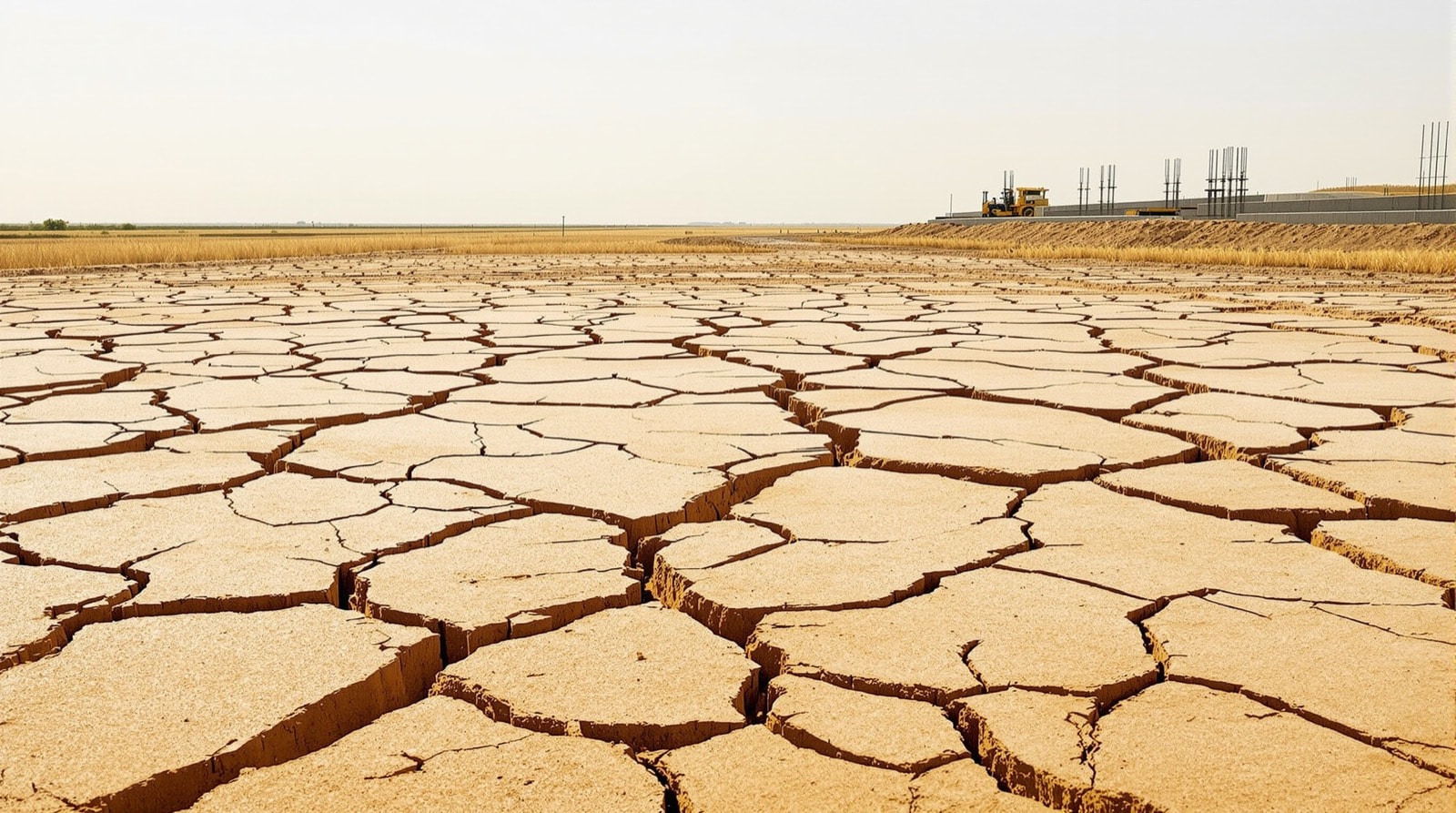
If you had to reduce North Texas concrete practice to one sentence, it would be this: the ground moves, so the concrete must not shrink. Almost everything distinctive about how slabs are designed, specified and placed across the Dallas-Fort Worth region follows from the behaviour of the clay beneath them.
The soils
Much of the eastern and central metroplex sits on Cretaceous marine clays and clay shales — the Eagle Ford and Taylor groups most prominently — which contain a high proportion of smectite clay minerals. These minerals take water into their crystal structure and swell, then release it and shrink. The seasonal cycle of wet winters and severely dry late summers drives that movement through a range that can exceed several inches of vertical heave at the surface, and it does so unevenly: more at the perimeter of a building than at the centre, more under a downspout than under a paved apron, more where a large tree draws moisture out of the soil.
Differential movement, not total movement, is what damages structures. A slab that rises uniformly is harmless; a slab whose edges rise while its centre stays put is a beam in bending with no one having designed it as one.
What that produces in construction practice
Three foundation strategies dominate, and each has concrete consequences.
Stiffened ground-supported slabs, either conventionally reinforced or post-tensioned, with a grid of deep stiffening beams cast integrally. The slab is designed to be stiff enough to span or cantilever over the anticipated soil movement. Post-tensioned residential slabs became the regional norm decades ago and remain so.
Moisture-conditioned or select-fill subgrades, in which the active clay is removed and replaced, or is treated with lime and compacted at a controlled moisture content, to reduce the potential movement before anything is cast.
Drilled piers with structural slabs and a void space or carton form beneath, so the structure bears on stable material well below the active zone and the clay is free to move without touching the building. This is standard for anything substantial.
All three impose restraint. A stiffened slab is heavily restrained by its own beam grid and by friction on the subgrade; a structural slab is restrained by its piers. Restrained concrete that shrinks cracks, so drying shrinkage becomes the property the specification is really trying to control, whatever the strength line says.
Controlling shrinkage in the mix
Drying shrinkage is driven principally by paste volume and by water content. The levers, in rough order of effectiveness:
- Use the largest nominal maximum aggregate size the section and reinforcement spacing permit, and a well-graded combined gradation. Both reduce the paste fraction for the same workability.
- Keep total water down. Achieve workability with water-reducing admixtures rather than with water, and resist slump-restoring water addition at the truck.
- Avoid over-cementing. Excess cementitious content raises paste volume and shrinkage without buying durability, and a high-cement mix in hot weather also sets fast.
- Consider shrinkage-reducing admixtures where the restraint condition is severe and the cost is justified.
- Cure properly. Curing does not eliminate ultimate shrinkage, but it delays drying until the concrete has enough tensile capacity to resist the restraint stress, which is what determines whether the shrinkage cracks.
The proportioning method behind these levers is set out under mix design, and the drying-shrinkage test used to verify a mix is described under testing.
Local materials
Coarse aggregate is predominantly crushed limestone from the Cretaceous formations south and west of the metroplex, with siliceous river gravel from the Trinity and Brazos alluvium as the alternative. The limestone is sound and widely used, and its slightly higher absorption is handled routinely at the plant by moisture correction — but it means aggregate moisture management is a live quality variable rather than a formality.
Fine aggregate is siliceous river sand, whose fineness modulus varies enough between pits that crews notice a change in finishing behaviour when a plant switches sources. Cement haul distances are unusually short thanks to the cement manufacturing concentration in the Ellis County area, which historically kept mixes economical. Fly ash was abundant from regional lignite generation and is less so now; slag cement, harvested ash and blended portland-limestone cements have taken up part of that role, and replacement levels have shifted accordingly.
Weather
North Texas has hot summers with low relative humidity and steady wind — a combination that produces high evaporation rates and plastic shrinkage cracking on flatwork with very little warning. Windbreaks, evaporation retarders, fog spraying and prompt curing matter more here than the air temperature alone suggests. The measures are set out under curing and protection.
Winter freezing occurs but is brief and shallow in most years, so entrained air is generally specified only for exterior flatwork and structures with genuine freeze-thaw or deicing exposure rather than as a default. Occasional severe winter events do occur, and cold-weather protection planning is not optional simply because the average winter is mild.
Where to look next
Regional supply structure and delivery scheduling are covered under ready-mix supply in the metroplex. Aggregate reactivity and gradation are under aggregates. Code requirements for exposure and durability come from the American Concrete Institute structural concrete code as adopted and amended locally.