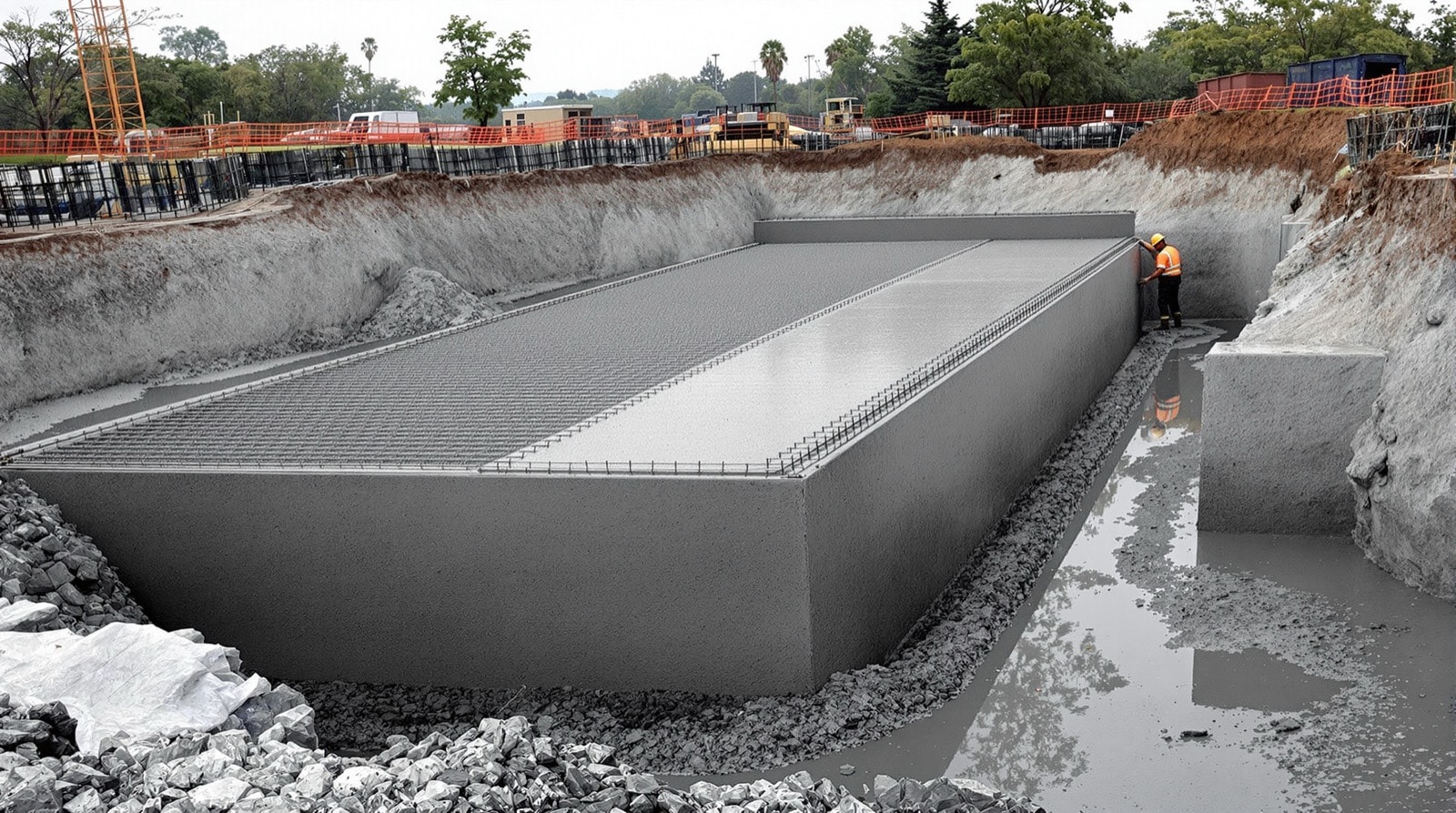
Gulf Coast concrete practice is organised around two facts: the material is placed in heat and humidity for most of the year, and a large share of it sits in a chemically aggressive environment for the rest of its life. Neither is exceptional individually; together they make durability a design requirement rather than an assumed by-product of strength.
Hot-weather concreting
Heat affects concrete in four ways at once. Hydration accelerates, so setting time shortens and the finishing window narrows. Slump loss accelerates, so the concrete stiffens between the plant and the chute. Water demand for a given slump rises, which tempts crews toward the one intervention that must be resisted. And ultimate strength falls: concrete that cures hot gains strength quickly at early ages and ends up weaker at twenty-eight days than the same mix cured moderately.
The controlling field variable is the evaporation rate, which combines concrete temperature, air temperature, relative humidity and wind speed. High humidity suppresses evaporation, which is why plastic shrinkage cracking is a smaller problem here than in the drier interior — but the same humidity extends the wait for bleed water to leave a slab, so finishing crews wait far longer than they would inland, and premature finishing that seals bleed water beneath the surface is a recurring cause of blistering and delamination.
Standard countermeasures: cool the mixing water or replace part of it with ice, shade and sprinkle aggregate stockpiles, dampen subgrade and forms without leaving free water, schedule large placements at night or before dawn, provide windbreaks, use evaporation retarders between finishing passes, and begin curing the moment finishing ends. The detail is under curing and protection, and the worker-safety dimension is covered by the Occupational Safety and Health Administration.
Mass concrete
The region's industrial base produces a great deal of mass concrete: large equipment and vessel foundations, thick mats, heavy pile caps. In a large placement the heat of hydration cannot escape, so the core temperature rises well above ambient and then cools slowly. Two failure modes follow. If the difference between the hot core and the cooler surface becomes too large, the surface cracks in tension. And if the core exceeds roughly 158 degrees Fahrenheit, delayed ettringite formation becomes a risk — an internal expansive reaction that cracks the concrete years later.
Control is a combination of mix and method: high replacement of portland cement with slag cement or fly ash to slow and reduce heat generation, the largest practical aggregate size to cut paste content, pre-cooling of the mix, insulation of the surfaces to reduce the differential rather than to cool the core, staged placement, and in the largest elements, embedded cooling pipes. A thermal control plan with monitoring at core and surface is standard on this work.
Chemical exposure
Sulfate attack. Sulfates in soil and groundwater react with hydrated cement phases to form expansive products that disrupt the paste. Defence is a combination of low water-cement ratio, sulfate-resisting cement types, and generous supplementary cementitious material replacement, with the required severity graded by the measured sulfate concentration in the soil or water.
Chloride ingress and reinforcement corrosion. Near the coast and on marine structures, chlorides penetrate the concrete and depassivate the reinforcement, after which corrosion products expand and spall the cover. The defences are permeability and cover: a dense, low-ratio, well-cured, pozzolan-rich paste, adequate and properly maintained cover depth, and where warranted, corrosion-inhibiting admixtures, coated or corrosion-resistant reinforcement, or cathodic protection.
Acid and chemical attack in process areas. Portland cement paste is alkaline and is attacked by acids; concrete alone is not a chemical-resistant material. Protection is by barrier — chemically resistant coatings, membranes or linings — with the concrete providing the substrate. Specifications for containment slabs therefore emphasise low permeability, crack control and a surface suitable for the coating system.
Guidance on all three exposure classes is set out in the American Concrete Institute code and durability guides.
Alkali-silica reaction
Because much of the region's coarse aggregate is siliceous river gravel, some of it containing reactive constituents, alkali-silica reaction mitigation is routine practice rather than an exception. The standard measures are aggregate reactivity testing, limits on total alkali contributed by the cementitious materials, and supplementary cementitious material replacement at a level demonstrated to suppress expansion for that specific aggregate. The mechanism is described under aggregates.
Ground and water
The coastal plain is flat, soft and saturated. Groundwater is shallow, deep foundations are the norm for anything of size, and historic subsidence has left parts of the region sensitive to differential settlement. For slabs on ground, the consequences are practical: a saturated subgrade cannot absorb bleed water, so bleeding is slower and finishing later; vapour retarder placement matters greatly where moisture-sensitive floor coverings will be installed; and drainage and detention structures form a steady share of regional concrete demand.
Where to look next
Materials availability, plant network shape and scheduling in this market are covered under ready-mix supply on the Gulf Coast. Verification of the durability properties discussed here — permeability, shrinkage, air-void structure — is under testing.