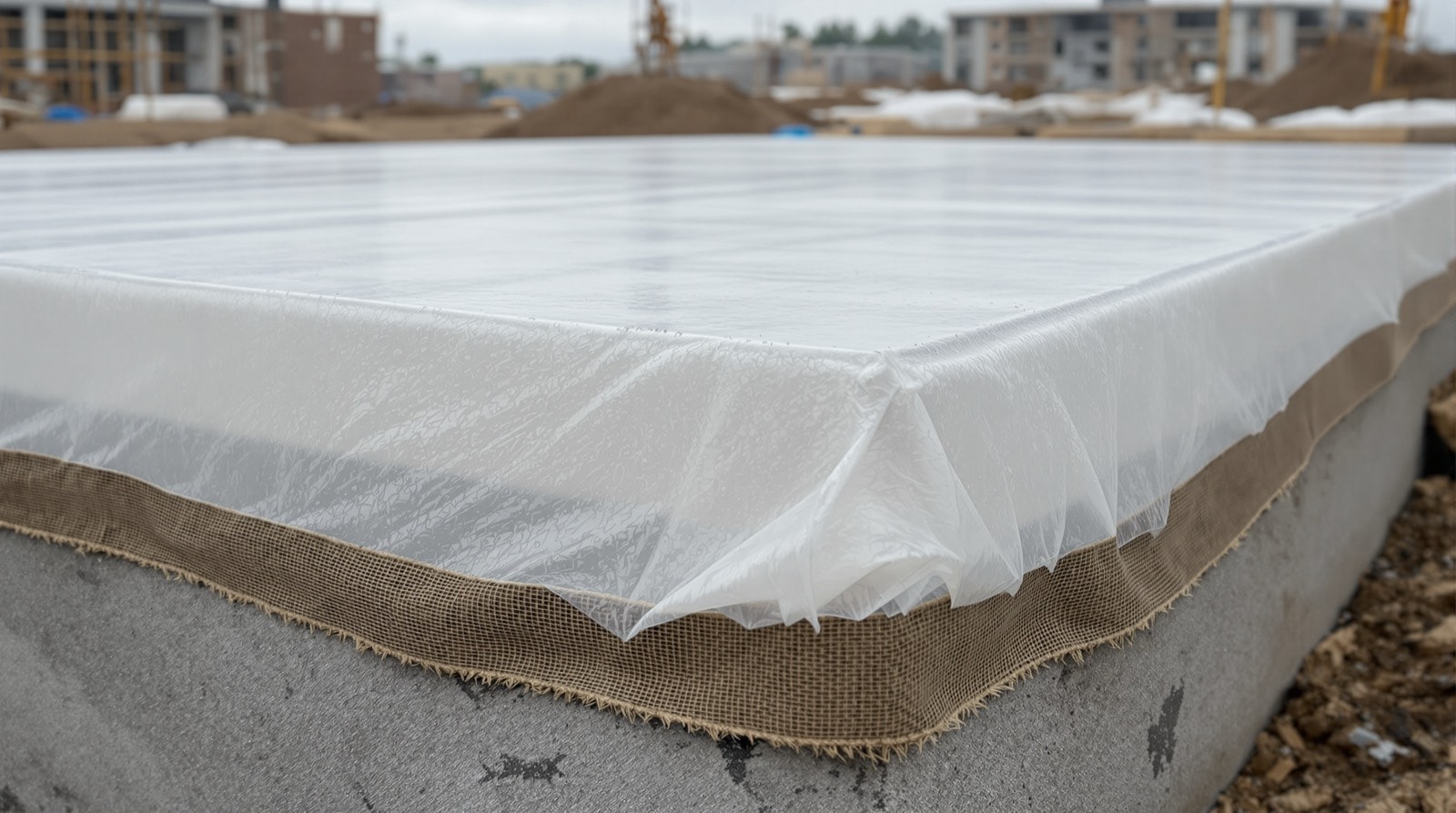
Curing is the maintenance of adequate moisture and temperature in freshly placed concrete so that hydration can continue. It is the least expensive intervention available on a concrete job and the one most routinely abandoned when the schedule tightens. Concrete that is allowed to dry at three days will never reach the strength or the durability that its proportions promised, and no amount of later attention recovers it.
Why concrete needs curing at all
Cement hydration is a chemical reaction that requires liquid water. It also requires space: the reaction products grow into water-filled capillary pores, and if those pores empty, growth stops. Below about eighty percent internal relative humidity, hydration effectively ceases, and it does not resume in any useful way when moisture returns.
The loss is concentrated exactly where it hurts. The surface dries first, so the outer few millimetres — the part that resists abrasion, carbonation, chloride ingress and freeze-thaw — is the part that under-hydrates. A poorly cured slab can meet its cylinder strength comfortably, because the cylinders were cured in a tank, and still dust, craze and scale in service. Cylinder strength measures the mix; surface quality measures the curing.
The magnitude is not marginal. Comparative testing consistently shows a large fraction of potential strength forfeited when moist curing stops within the first few days, with the penalty rising as the water-cement ratio falls, because a low-ratio paste has less internal water to spare and self-desiccates faster.
Methods
Curing methods divide into those that add water and those that retain it.
- Ponding and immersion — the most effective, practical only on flat work with a containable perimeter. It also provides temperature control on hot days.
- Continuous fogging or sprinkling — effective, but must genuinely be continuous. Intermittent wetting and drying is worse than no wetting at all, because each cycle drives moisture movement and surface stress.
- Wet coverings — burlap, cotton mats or absorbent fabric kept saturated. Reliable if someone is assigned to keep them wet; useless the moment they dry, and a dry covering left in the sun becomes an insulator working against you.
- Impervious sheeting — polyethylene or reinforced paper, sealed at laps and edges. Cheap and effective, but sheeting laid in contact with a surface that still has bleed water produces mottled discoloration, which matters on architectural work.
- Membrane-forming curing compounds — sprayed resin, wax or polymer emulsions that leave a moisture-retaining film. The most common method on large flat work by far. Coverage rate and uniformity are everything: a compound applied thin or unevenly retains far less than its rating, and the correct application window is immediately after the bleed-water sheen disappears.
- Formwork left in place — vertical elements cure reasonably well inside their forms provided exposed tops are protected and, in dry weather, the forms are wetted. Once forms are stripped, curing must continue by another method.
Curing compounds carry a compatibility trap worth naming: many of them prevent adhesion of subsequent toppings, coatings, membranes and tile adhesives. Where a floor will receive a finish, either use a compound documented as compatible, or use sheeting and remove it. The American Concrete Institute guidance on curing sets out the methods and the durations in detail.
Plan the curing handover
Curing failures often occur at a boundary: when the finishing crew leaves, when protection passes to another trade, or when access opens before anyone has checked the surface. The method should therefore name who starts it, who inspects it and who has authority to repair a break in protection. For a curing compound, the record should include the required coverage, the area treated, the quantity used and the surface conditions at application. For wet curing, it should identify how continuous moisture will be maintained.
A walk-down should include slab edges, construction joints, penetrations, formed faces and any route used by workers or equipment. Wind can lift sheeting, foot traffic can open laps, and form stripping exposes new surfaces that need immediate attention. A short curing log linking these checks to weather, access changes and the time protection began gives the later strength and surface observations useful context.
How long
Common practice for ordinary portland cement mixtures is a minimum of seven days of moist curing at temperatures above about fifty degrees Fahrenheit, or until the concrete reaches roughly seventy percent of its specified strength. Neither figure is arbitrary: both approximate the point at which the capillary network has become discontinuous enough that further drying does limited damage.
Mixes with substantial fly ash or slag replacement need longer, because the pozzolanic reaction runs behind the cement reaction. Mixes with high early-strength cements or accelerators may need less. Where the structure's durability depends on low permeability rather than on strength alone — water-retaining structures, marine exposure, deicing salt exposure — extending the curing period is the highest-value change available.
Hot-weather protection
Heat accelerates hydration, reduces the time available for finishing, and increases evaporation. The controlling variable is not air temperature but evaporation rate, which combines concrete temperature, air temperature, relative humidity and wind speed. Above roughly 0.2 pounds per square foot per hour, plastic shrinkage cracking becomes likely; wind is usually the dominant term, and a windbreak often does more than anything else on the site.
Practical measures include placing at night or in the early morning, cooling the mixing water or substituting ice, shading and sprinkling aggregate stockpiles, dampening subgrade and forms, using an evaporation retarder film between finishing passes, and starting curing the moment finishing ends rather than at the end of the shift. Site heat exposure is also a worker-safety matter, and the Occupational Safety and Health Administration publishes the applicable guidance.
One thing that is not a remedy: adding water to the surface during finishing. Sprinkling water on a slab to make it work more easily raises the surface water-cement ratio and produces a weak, dusting wear layer. If the surface is drying too fast, the correct tool is an evaporation retarder or a fog spray fine enough not to accumulate.
Cold-weather protection
Cold slows hydration and, below freezing, stops it. Concrete that freezes before it reaches roughly 500 psi suffers permanent damage from ice expansion in the still-fluid paste — the strength loss can approach half, and it is not recoverable. Concrete that has passed that threshold tolerates one freezing cycle without lasting harm.
Protection means maintaining the concrete above about fifty degrees Fahrenheit for the first several days using insulating blankets, enclosures and heaters, and then removing that protection gradually. Rapid cooling of a warm surface produces thermal-shock cracking, so the standard guidance limits the permissible temperature drop in the first twenty-four hours after protection is withdrawn.
Heated enclosures introduce their own problem: direct-fired heaters raise carbon dioxide levels, and carbonation of a fresh surface produces a soft, chalky, permanently weak wearing layer. Vent combustion products outside the enclosure.
Curing is a specification item, not a courtesy
Because curing costs labour and delays access, it disappears unless it is specified with a method, a duration and a verification. The stronger specifications name the acceptable methods, require the curing compound application rate to be measured, and require maturity or in-place strength verification before curing is discontinued. Field-cured cylinders stored beside the structure — as distinct from the standard-cured cylinders used for acceptance — are the usual instrument, and their use is described under testing.